
Center for Christianity
and Scholarship
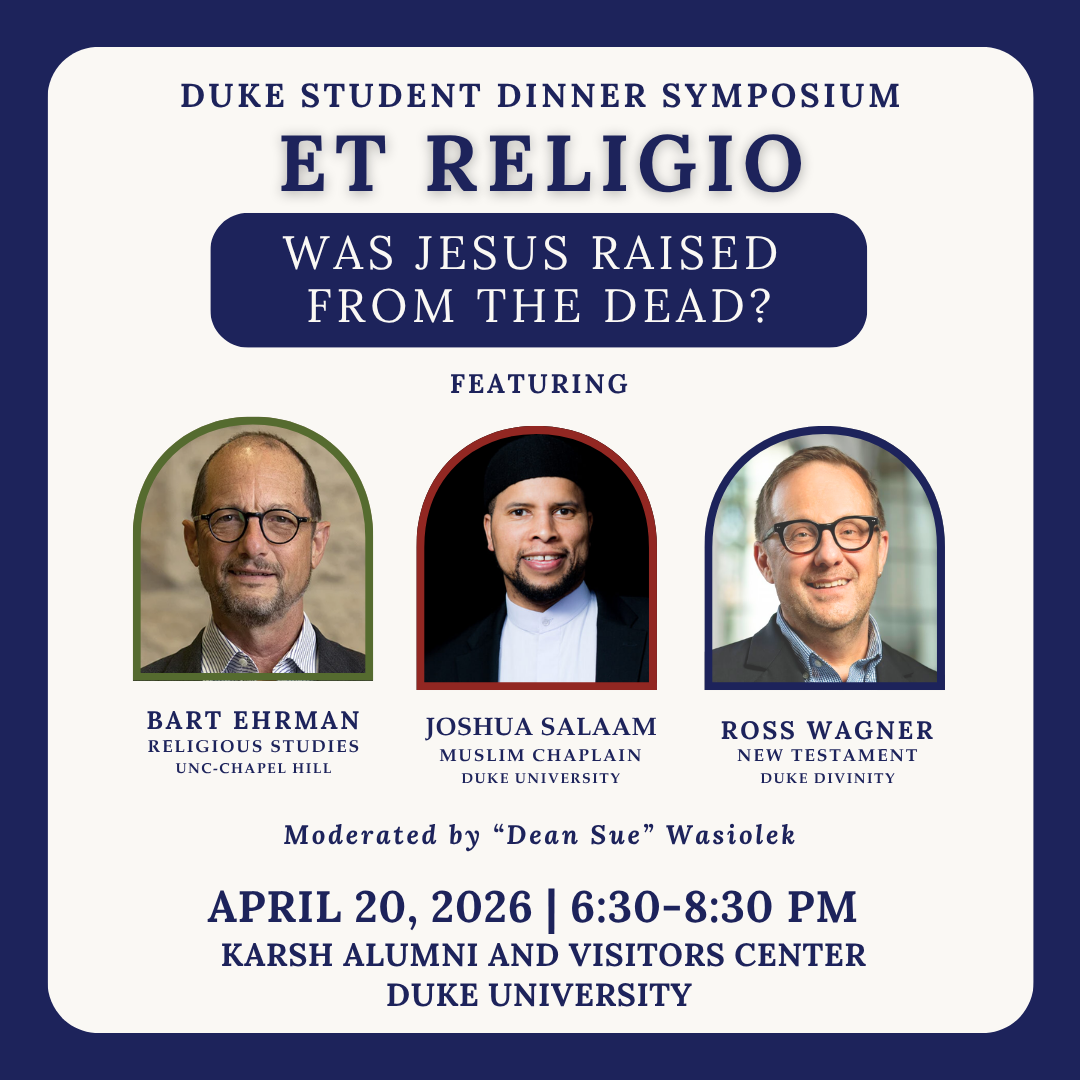
2026 Et Religio Graphic
et Religio Dinner Symposium Spring 2026

Date + Time:
April 20, 2026
6:30 p.m.–8:30 p.m.

Location:
Karsh Alumni and Visitors Center
2080 Duke University Rd, Durham, NC 

Please RSVP by April 12 to guarantee a meal.

This year’s et Religio event invites Duke University students to explore one of the most consequential and debated questions in religious history: Was Jesus raised from the dead? 

The conversation will feature three distinguished scholars and faith leaders who bring distinct perspectives to the question — Bart Ehrman, religious studies professor at UNC-Chapel Hill, from an agnostic-atheist standpoint; Ross Wagner, New Testament professor at Duke Divinity School, from a Christian perspective; and Joshua Salaam, Muslim chaplain at Duke and director of the Center for Muslim Life, from an Islamic tradition. Together, they will engage the historical, theological, and philosophical dimensions of the resurrection in a setting designed not for debate alone, but for genuine understanding. Following the seminar, participants will gather over a shared meal to continue the conversation in a spirit of curiosity, respect, and openness. 

The goal is to foster thoughtful, civil dialogue across differences — creating space to listen carefully, ask meaningful questions, and encounter new perspectives. Anticipate sitting with individuals from other faiths – not just like-minded friends. Whatever your beliefs or background, you are welcome at the table.

Speakers
Bart Ehrman

Bart Ehrman is the James A. Gray Distinguished Professor at the University of North Carolina at Chapel Hill. He completed his M.Div. and Ph.D. degrees at Princeton Seminary, where his 1985 doctoral dissertation was awarded magna cum laude. An expert on the New Testament and the history of Early Christianity, he has written or edited thirty books, numerous scholarly articles, and dozens of book reviews. Six of his books have been on the New York Times Bestseller list: Misquoting Jesus; God’s Problem; Jesus Interrupted; Forged; and How Jesus Became God. His books have been translated into twenty-seven languages. His next book, Love Thy Stranger: How the Teachings of Jesus Transformed the Moral Conscience of the West publishes in March 2026 by Simon & Schuster.

Joshua Salaam

Joshua Salaam has strong roots in the American Muslim community. He started attending national Muslim youth camps at the age of 12 and continued as a participant, counselor and speaker for over 30 years. Joshua entered the U.S. Air Force in 1995 and served as a Police officer for four years. He was a key contributor in establishing Friday prayer services on base for Muslim military members and went on to serve as an Imam in Goldsboro, NC for several years. After the military, Joshua immersed himself in community activism. He managed the Civil Rights department for the Council on American-Islamic Relations from 2000-2004 and helped oversee a Baltimore Muslim community and neighborhood development project from 2004-2007. Before starting at Duke in July 2018, Joshua worked with youth and families for 11 years at one of the largest Muslim communities in America. His diverse background gives him a unique perspective on many issues and helps him connect with students. He holds a Master’s Degree in Religious Studies and a Doctorate of Ministry from Hartford Seminary.

Ross Wagner

Specializing in Paul’s letters and in Septuagint studies, Ross Wagner seeks to contribute to the recovery of theological exegesis through careful investigation of the ways scriptural interpretation shaped early Jewish and Christian communities. His publications include Heralds of the Good News: Paul and Isaiah in Concert in the Letter to the Romans, Between Gospel and Election: Explorations in the Interpretation of Romans 9–11 (co-edited with Florian Wilk) and Reading the Sealed Book: Old Greek Isaiah and the Problem of Septuagint Hermeneutics. His current research aims to show that theological reflection on the meaning of Jesus’ life has, from the very beginning, required Christian interpreters to wrestle with the textual and linguistic plurality of the scriptures in their witness to God’s actions in Jesus the Messiah. Wagner serves on the editorial boards of New Testament Studies, The Journal of Theological Interpretation, and Wissenschaftliche Untersuchungen zum Neuen Testament. He was a Humboldt Research Fellow at the University of Göttingen in 2006–2007, 2010 and 2015, and he spent 2009–2010 as a member in residence at the Center of Theological Inquiry in Princeton. An Anglican priest, he serves as volunteer clergy in a local parish and takes an active part in the Anglican-Episcopal House of Studies.